
Are you ready to test your kitchen vocabulary in English?
In this third kitchen items quiz, you’ll see a picture and choose the correct answer (A, B, or C). This interactive format helps beginner learners improve vocabulary recognition and build confidence in everyday English.
👉 Watch the video below and try to score 20/20!
Why Learning Kitchen Vocabulary Is Important?
Kitchen vocabulary is part of daily life. Students hear these words in:
- Cooking shows
- Restaurant conversations
- Family discussions
- Grocery shopping
- ESL listening exams
Understanding words like saucepan, dishwasher, or spatula helps you follow cooking videos, home conversations, and everyday situations more easily.
Mastering household vocabulary helps learners:
✔ Speak more naturally
✔ Describe daily routines
✔ Understand native speakers
✔ Feel more confident using English
Small words create big progress.
Free Printable Kitchen Vocabulary Worksheet
I created a free printable worksheet with the same questions from the video.
You can:
- Print it and write your answers
- Use it in the classroom
- Assign it as homework
- Review vocabulary later
👉 Download the free worksheet here.
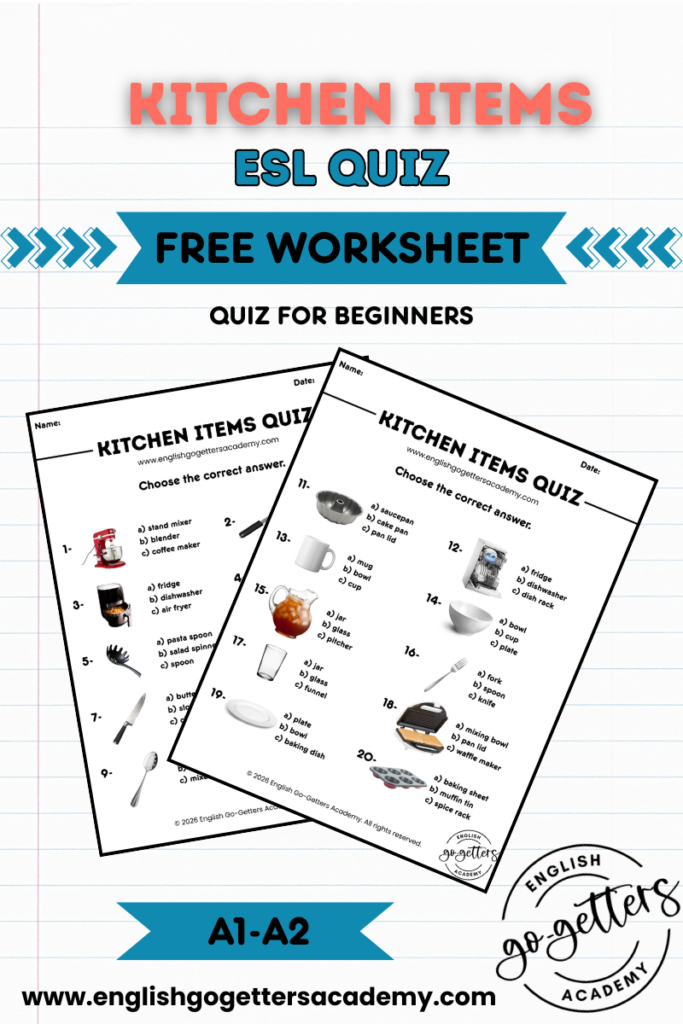
Remember: The answer key is only available in the video.
Extra Practice
Exercise 1: Fill in the Blank
- Amy made a __________ of lemonade for the party.
- We use a __________ to make waffles on Sundays.
- Please wash the dishes in the __________.
- We eat cereal in a __________ every morning.
- The __________ keeps the coffee warm for hours.
(Answers below!)
Exercise 2: Make Your Own Sentences
Choose 3 kitchen items from the list and write your own sentences.
Example:
- I drank coffee from a mug.
- She washed the fork in the sink.
- The bowl is in the fridge.
Writing sentences helps move vocabulary into long-term memory.
Answers
- Amy made a pitcher of lemonade for the party.
- We use a waffle maker to make waffles on Sundays.
- Please wash the dishes in the sink.
- We eat cereal in a bowl every morning.
- The thermos keeps the coffee warm for hours.
What Kitchen Items Are in This Quiz?
This ESL quiz includes common kitchen vocabulary such as:
- Stand mixer
- Spatula
- Pitcher
- Bowl
- Plate
- Fork
- Saucepan
- Napkins
- Slotted spoon
- Dishwasher
- Sink
- Glass
- Mug
- Muffin tin
- Waffle maker
- Air fryer
- Pasta spoon
- Thermos
- Chef’s knife
- Cake pan
These are everyday words used in cooking, baking, cleaning, and setting the table.
Kitchen Items English Vocabulary Quiz – Frequently Asked Questions
This quiz is designed for A1–A2 English learners (beginner to elementary level). It focuses on basic everyday vocabulary.
Yes. Teachers can use it for warm-ups, review lessons, homework assignments, or ESL centers. The printable worksheet makes classroom use easy.
A glass is usually used for cold drinks like water or juice. A mug has a handle and is commonly used for hot drinks like coffee or tea.
A slotted spoon has holes that allow liquid to drain. It is used to remove food from water or sauce.
Yes. There is a free printable worksheet with the same questions from the video. The answers are only available inside the video.
Watch the Full Kitchen Vocabulary Series
This is Video 3 in our kitchen vocabulary series.
You may also like:
Practice more vocabulary in our first kitchen items quiz for beginners.
And also, the second video.
Repeating vocabulary in different quizzes strengthens memory and improves fluency.
Continue Your ESL Practice
Building strong vocabulary takes practice — and every quiz brings you one step closer to fluency. Keep reviewing these kitchen items, use them in real sentences, and don’t forget to download the free worksheet for extra practice. The more you see, hear, and use new words, the faster they become natural. Keep learning, keep practicing, and I’ll see you in the next quiz!
Happy learning,
Vanessa
English Go-Getters Academy