
Hello English Go-Getters!
In this present continuous tense practice for beginners, you will learn and practice how to make affirmative sentences using:
👉 am / is / are + verb-ing
This beginner-friendly present continuous ESL quiz and post includes:
- a video quiz
- a free printable worksheet PDF (answers found only in the video)
- clear grammar explanation with examples
- added practice
- a challenge practice using phrasal verbs
Most sentences describe actions happening now or around now, and you will also see a few examples with future time expressions like tonight — an A2 use of this tense.
Watch the Present Continuous Quiz
Watch the video and choose the correct present continuous sentence.
This is a fun and effective way to practice present continuous verbs in context.
How many answers did you get right?
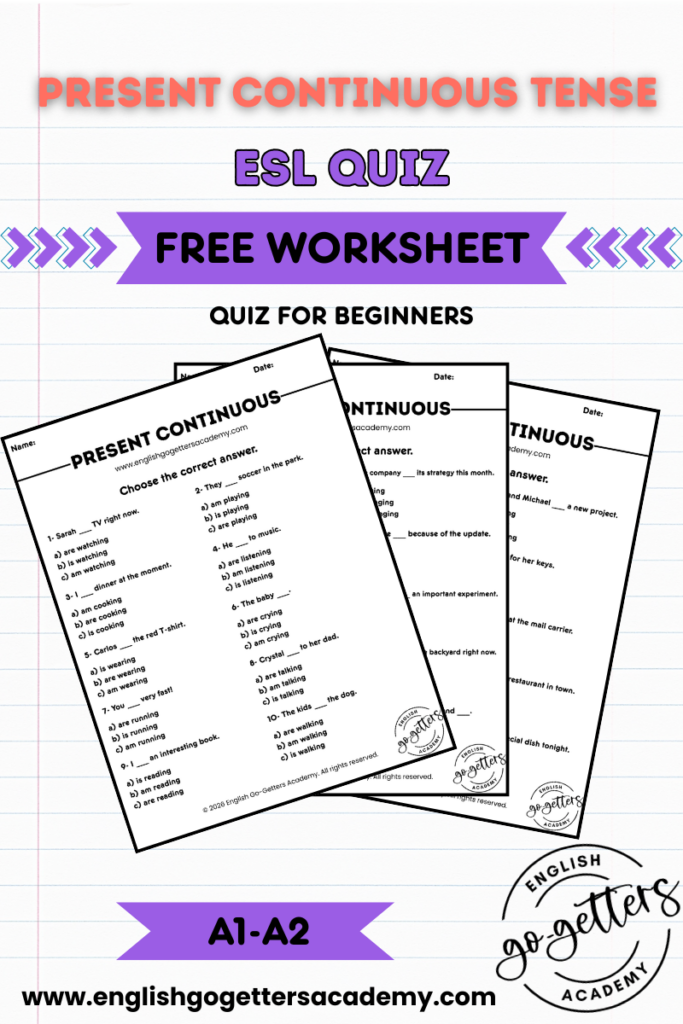
Download the Present Continuous Worksheet
Download the present continuous worksheet PDF and practice offline. The worksheet contains Present Continuous Tense practice for beginners and is:
✔ Perfect for self-study
✔ Great for ESL teachers and classrooms
✔ Same exercises as the quiz-video
✔ Answers included in the video
Present Continuous Tense – Form, Structure & Rules
Present Continuous Definition
The present continuous tense is used for:
- actions happening now
- temporary actions happening around now
- future arrangements (A2 level)
Present Continuous Form
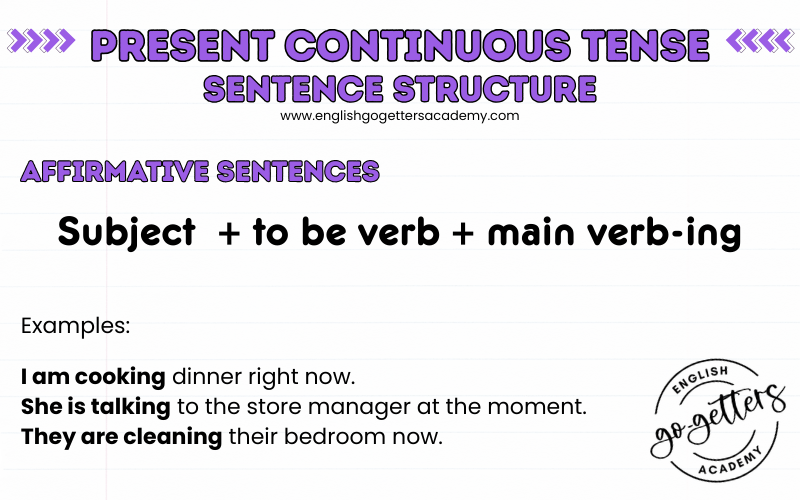
We form the present continuous with:
subject + am / is / are + verb-ing
Present Continuous Structure
| Subject | Vert to Be | Main Verb |
| I | am | studying |
| He/She/It | is | studying |
| We/You/They | are | studying |
Present Continuous Tense Examples
I am reading an interesting book.
She is talking to her dad.
They are playing soccer in the park.
We are studying for the exam this week.
These are common present continuous sentences for beginners.
Present Continuous Rules
- Use am with I
- Use is with he, she, it
- Use are with you, we, they
- Add –ing to the main verb
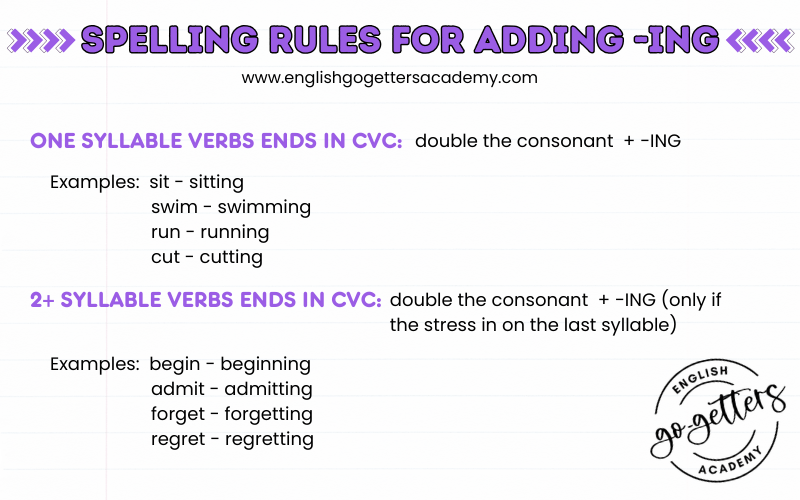
Spelling Rules for Adding -ING
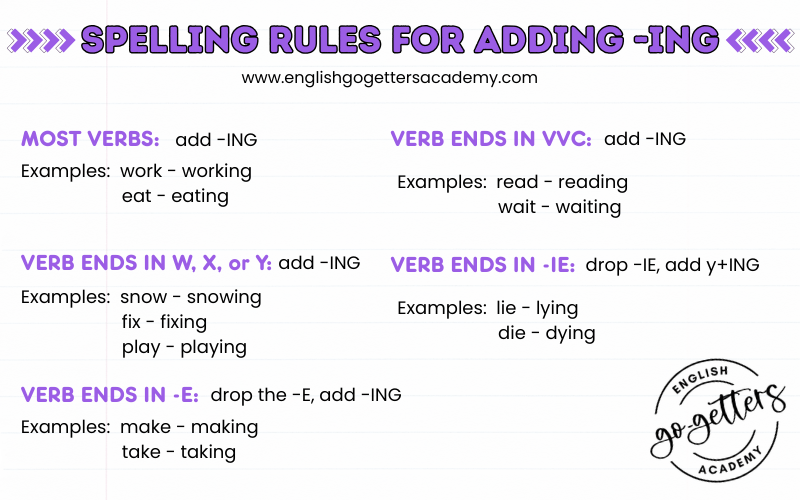
When we form the present continuous tense, we add –ing to the main verb.
Most verbs are easy:
work → working
eat → eating
play → playing
But some verbs change their spelling.
1. Double the consonant + –ing
We double the last consonant when:
- the verb is short
- it has one vowel + one consonant at the end
run → running
sit → sitting
swim → swimming
stop → stopping
get → getting
Examples:
She is running in the park.
They are sitting on the sofa.
He is swimming in the pool.
2. Do NOT double the consonant
We do not double if:
❌ the verb ends in two consonants
help → helping
work → working
❌ the verb ends in two vowels + consonant
eat → eating
read → reading
3. Verbs ending in –e
Drop the –e and add –ing
make → making
write → writing
dance → dancing
Example:
She is writing an email.
4. Verbs ending in –ie
Change –ie → –y + ing
lie → lying
die → dying
Example from the quiz:
Jane is lying in bed and reading a magazine.
Present Continuous for Actions Happening Now
We use the present continuous for actions at the moment of speaking.
Look for words or expressions like:
- now
- right now
- at the moment
Examples:
The baby is sleeping right now.
I am cooking dinner at the moment.
Present Continuous for Temporary Actions
We also use this tense for actions happening around now, even if not at this exact second.
Examples from the quiz:
The students are studying for the exam this week.
My cousin is living in London this year.
The company is changing its strategy this month.
This use is very common in English.
Present Continuous for Future Arrangements
Sometimes we use the present continuous for future plans that are already scheduled.
In the quiz you can see:
The neighbors are having a party tonight.
The chef is preparing a special dish tonight.
The structure is the same:
am / is / are + verb-ing
Only a future time expression is added to express a future arrangement.
Present Continuous Practice for Beginners
Fill in the blanks below for added practice:
1️⃣ I ______ (write) a message to my teacher right now.
2️⃣ The children ______ (play) in the garden at the moment.
3️⃣ She ______ (study) for her English test this week.
4️⃣ We ______ (have) lunch at a new café today.
5️⃣ He ______ (run) very fast in the race now.
6️⃣ My parents ______ (travel) to Chicago this weekend.
7️⃣ The dog ______ (sit) next to the door.
8️⃣ I ______ (make) a cake for my friend’s birthday.
9️⃣ They ______ (watch) a really interesting movie tonight.
🔟 The students ______ (work) on a new project this month.
Challenge Time!
Want an extra challenge? Write sentences in the Present Continuous tense using the following phrasal verbs:
- wake up (stop sleeping)
- sit down (take a seat)
- come in (enter a place)
- go out (leave home to do something)
- take off (remove clothes/shoes)
Examples:
I am waking up earlier this month to study English.
They are sitting down at the table right now.
They are sitting down at the table right now.
We are going out with some friends tonight.
He is taking off his shoes at the moment.
Answers
1️⃣ am writing
2️⃣ are playing
3️⃣ is studying
4️⃣ are having
5️⃣ is running
6️⃣ are traveling / are travelling (both OK)
7️⃣ is sitting
8️⃣ am making
9️⃣ are watching
🔟 are working
Present Continuous – Frequently Asked Questions
Subject + am / is / are + verb-ing
We use the Present Continuous for:
– actions happening now
– temporary actions
– future arrangements (A2)
It is designed for A1–A2 learners.
Most sentences focus on basic use, with a small introduction to the future use.
You can download the worksheet in this post and practice with the video. The answers are only found in the video.
Next you can learn:
– negative sentences
– questions
– present continuous for future
Continue Learning
Next in the present continuous series:
➡️ Present continuous negative (coming soon)
➡️ Present continuous questions (coming soon)
The present continuous is one of the most important tenses in English, and now you can use it to talk about what is happening right now, what is happening around this time, and even your future plans.
Don’t stop here — repeat the quiz, complete the worksheet, and write your own examples in the comments.
The more you practice, the more natural your English will become.
Happy learning English Go-Getter!
Vanessa
English Go-Getters Academy