
Apostrophes are one of the most confusing punctuation marks in English. Many learners struggle with apostrophe rules, apostrophe s usage, plural apostrophes, and possessive apostrophes.
Understanding how apostrophes are used in English grammar helps writers show possession, ownership, and contractions clearly in sentences.
In this guide, you will learn:
- when apostrophes are used
- the most important apostrophe s rules
- how to use possessive apostrophes
- whether the apostrophe goes before or after the s
- apostrophes with names ending in s
- examples of apostrophes usage in sentences
You can also test your knowledge with a 20-question apostrophes quiz and download a free apostrophes worksheet PDF for extra practice.
Take the Apostrophes Quiz
Want to test your understanding of apostrophe rules and possessive apostrophes?
Try the quiz below and see how well you understand using apostrophes in English.
This quiz includes 20 questions about apostrophes, covering topics such as:
- apostrophe s rules
- apostrophe s after s
- apostrophes plural possession
- apostrophes with names
- apostrophes and possession
- apostrophes for last names
Try to answer each question before the timer ends and keep track of your score.
At the end of the quiz, count your correct answers and see your final score.
Download the Apostrophes Worksheet PDF
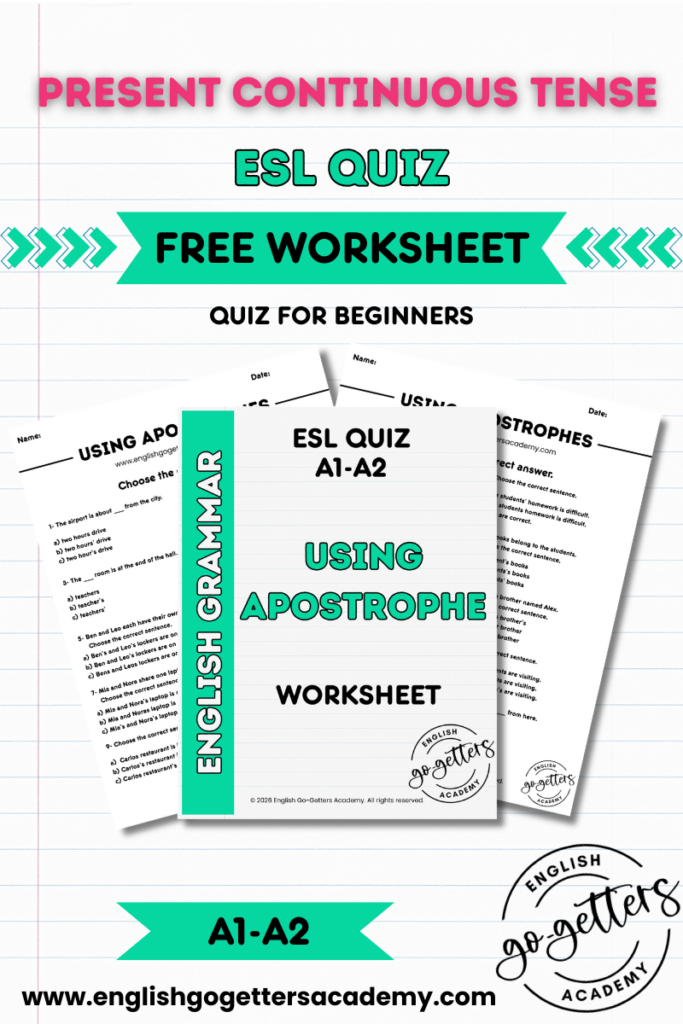
If you want to practice using apostrophes in English, download the Apostrophes Worksheet PDF and try the quiz on paper.
The worksheet includes:
- the same apostrophes quiz questions from the video
- practice with apostrophe s rules and possessive apostrophes
- questions about apostrophe after s and plural possession
- examples of apostrophes usage in sentences
⚠️ Important:
The worksheet does not include the answers.
To check your answers, watch the apostrophes quiz video above, where each question is explained.
This allows you to test your knowledge first and then learn from the explanations in the video.
This worksheet is helpful for ESL learners, English students, and teachers who want extra practice with apostrophes and possession.
When Are Apostrophes Used?
Many learners ask when to use apostrophes in English.
Apostrophes are mainly used for two purposes:
1️⃣ To show possession or ownership
2️⃣ To show missing letters in contractions
Examples:
- Maria’s book
- The teacher’s desk
- It’s raining today
The first two sentences show apostrophes to show possession, while the third sentence shows a contraction.
Understanding when apostrophes are used helps avoid common grammar mistakes.
Apostrophe S Rules for Possession (Singular Nouns)
One of the most common apostrophe s rules is using ‘s to show possession.
Structure:
noun + ’s + object
Examples:
- Maria’s book
- Daniel’s car
- Emma’s backpack
- the teacher’s desk
- the baby’s toy
Example sentence:
Emma’s backpack is blue.
These are examples of possessive apostrophes showing ownership.
Apostrophe After S: Plural Possession
Many learners search for:
- apostrophe s after s
- apostrophe rules after s
- apostrophe before or after the s
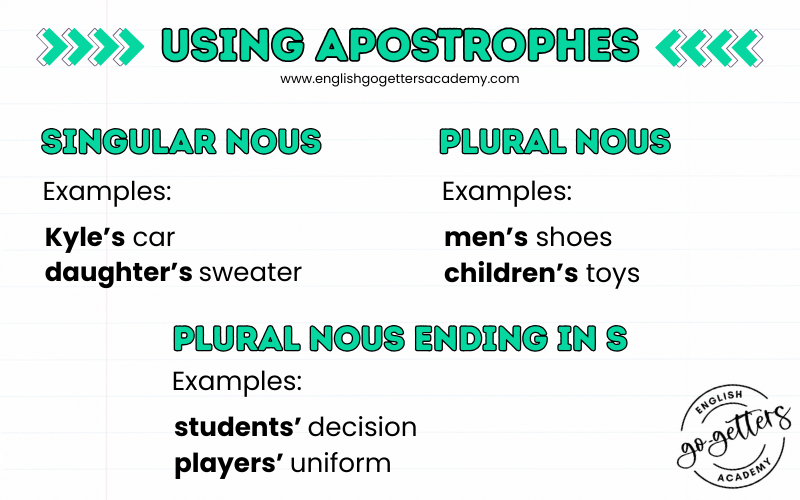
So we know this topic is challenging and can be confusing at times. When a noun is plural and ends in s, the apostrophe goes after the s.
Structure:
plural noun + ‘
Examples:
- the students’ homework
- the teachers’ meeting
- the players’ uniforms
- the dogs’ food
Example sentence:
The students’ homework is difficult.
This is called apostrophes plural possession.
Apostrophes With Irregular Plurals
Some plural nouns do not end in s.
Examples include:
- children
- men
- women
- people
For these nouns, we add ‘s.
Examples:
- the children’s toys
- the men’s shoes
- the women’s jackets
- the people’s choice
Example sentence:
The children’s toys are everywhere.
Apostrophes With Names Ending in S
Another common question is apostrophes with names ending in s.
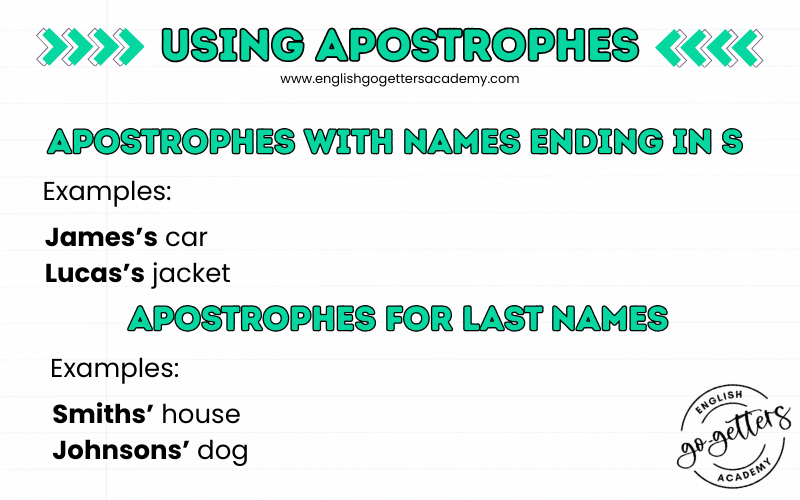
Most modern English style guides recommend adding ‘s.
Examples:
- James’s car
- Chris’s laptop
- Lucas’s jacket
Example sentence:
James’s car is parked outside.
These examples show apostrophes in names.
Apostrophes for Last Names (Family Names)
Apostrophes can also appear with family names.
Examples:
- the Smiths’ house
- the Johnsons’ dog
- the Williamses’ garden
Example sentence:
The Smiths’ house is on the corner.
This helps explain apostrophes for last names and apostrophes on last names.
Apostrophes Examples in Sentences
Seeing apostrophes examples helps learners understand how apostrophes are used in real English sentences.
Singular possession examples:
- Maria’s book is on the table.
- Daniel’s car is parked outside.
Plural possession examples:
- The students’ homework is difficult.
- The teachers’ meeting starts at nine.
Irregular plural examples:
- The children’s toys are everywhere.
- The men’s shoes are expensive.
Names with apostrophes:
- James’s car is outside.
- Chris’s laptop is broken.
Contractions:
- It’s raining today.
- Who’s coming to the meeting?
Common Apostrophe Mistakes
Many learners make mistakes when using apostrophes.
Here are some common errors.
Using Apostrophes for Plurals
Incorrect:
Apple’s for sale
Dog’s are friendly
Correct:
✔ Apples for sale
✔ Dogs are friendly
Apostrophes should not be used to make nouns plural.
Confusing Friend’s and Friends’
friend’s = one friend
friends’ = multiple friends
Examples:
My friend’s parents are visiting.
My friends’ parents are visiting.
Extra Practice
Fill in the blank with the correct apostrophe form.
1️⃣ Maria ___ book is on the table.
2️⃣ The students ___ homework is difficult.
3️⃣ The dog wagged ___ tail happily.
4️⃣ James ___ car is parked outside.
5️⃣ The children ___ toys are everywhere.
6️⃣ My friend ___ parents are visiting.
7️⃣ The teachers ___ meeting starts at nine.
8️⃣ ___ raining today.
9️⃣ The Smiths ___ house is on the corner.
🔟 The baby ___ toy is on the floor.
Challenge Practice
Fill in the blank with the correct apostrophe form.
1️⃣ My two brothers share a car.
This is my _______ car.
2️⃣ The toys belong to the children.
The ______ toys are on the floor.
3️⃣ The decision belongs to the students.
The ______ decision surprised the teacher.
4️⃣ Chris has a new laptop.
This is ______ laptop.
5️⃣ The parents of my friend are visiting.
My ______ parents are visiting.
Why Apostrophes Are Important in English Writing?
Apostrophes are an important punctuation mark in English grammar. They help writers show possession, ownership, and contractions clearly in sentences.
Understanding apostrophe rules helps learners:
- write correct sentences
- understand singular and plural nouns
- recognize contractions in English
- avoid common punctuation mistakes
Practicing apostrophes usage through examples and quizzes makes these grammar rules easier to remember.
Continue Learning
If you want to continue improving your English, explore these posts:
- Present Continuous Tense
- English Vocabulary: Kitchen Items
- English Vocabulary: Countries & Flags
- English Vocabulary: Flowers
These grammar guides include explanations, examples, and quizzes to help English learners improve their English.
FAQ – Apostrophes
Apostrophes are used to show possession or missing letters in contractions.
Example:
Maria’s book
It’s raining
Possessive apostrophes show ownership.
Example:
The teacher’s desk
The students’ homework
If a plural noun ends in s, add the apostrophe after the s.
Example:
students’ books
teachers’ lounge
Most modern English style guides recommend adding ‘s.
Example:
James’s car
Chris’s laptop
Plural nouns do not use apostrophes unless they show possession.
Example:
Students are studying.
Students’ books are on the table.
friend’s = one friend
friends’ = multiple friends
Examples:
My friend’s parents are visiting.
My friends’ parents are visiting.
Answers
Extra Practice
1️⃣ Maria’s
2️⃣ students’
3️⃣ its
4️⃣ James’s
5️⃣ children’s
6️⃣ friend’s
7️⃣ teachers’
8️⃣ It’s
9️⃣ Smiths’
🔟 baby’s
Answer to the Challenge Practice
1️⃣ brothers’
2️⃣ children’s
3️⃣ students’
4️⃣ Chris’s
5️⃣ friend’s
Don’t stop here!
The more you practice, the more natural your English will become.
Happy learning, English Go-Getter!
Vanessa
English Go-Getters Academy