
Hello English Go-Getters!
In this present continuous tense practice for beginners, you’ll learn how to make negative sentences in a simple and natural way.
This time, we’re focusing on:
👉 am not / isn’t / aren’t + verb-ing
Because in real English, we don’t usually say is not — we say isn’t.
So in this quiz, you’ll practice grammar and also sound more fluent when you speak.
Just like in the previous post, this beginner-friendly ESL lesson includes:
✔ a video quiz
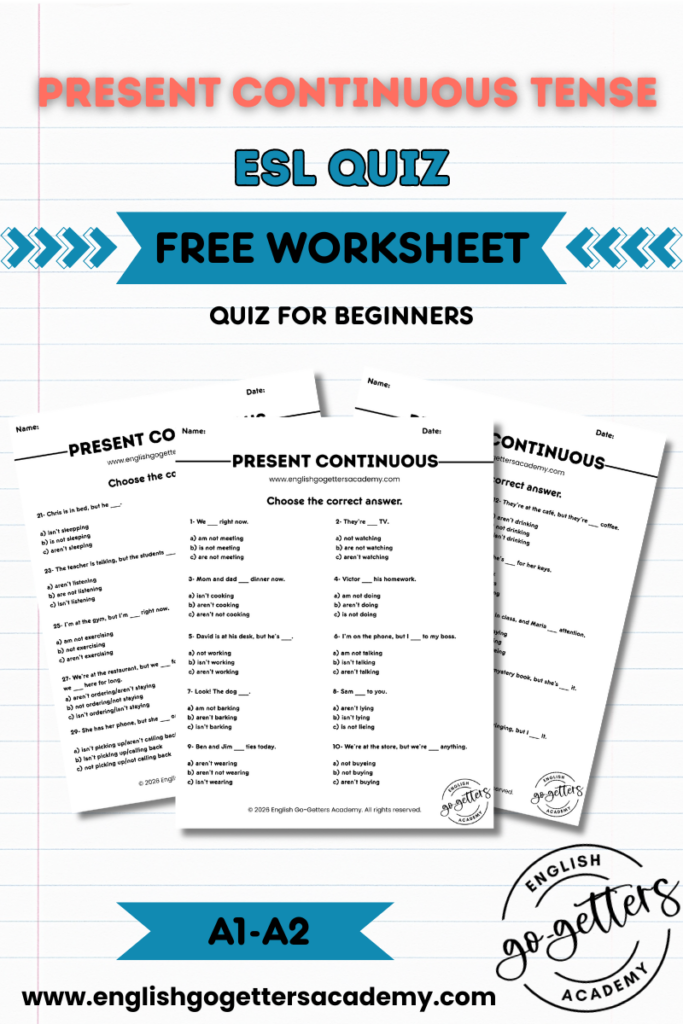
✔ a free printable worksheet (answers in the video)
✔ a clear grammar explanation
✔ extra practice
✔ a phrasal verb challenge
Most examples describe things that are not happening now.
However, you’ll also see a few A2-level future arrangements.
Watch the Present Continuous Negative Quiz
First, watch the video and choose the correct negative sentence.
This is not only fun — it’s also one of the most effective ways to learn grammar in context.
❌ is not working → ✅ isn’t working
❌ are not studying → ✅ aren’t studying
So… how many answers did you get right?
Download the Present Continuous Worksheet
Next, download the worksheet and practise offline.
This worksheet contains present continuous tense practice for beginners and is:
✔ perfect for self-study
✔ great for ESL teachers and classrooms
✔ the same exercises as the quiz video
✔ answers included in the video
Present Continuous Tense – Form, Structure & Rules
Present Continuous Definition
The present continuous negative is used for:
- actions that are not happening now
- temporary actions that are not happening around now
- future arrangements that are cancelled or not planned
In other words, it helps us describe what is not in progress.
Present Continuous Form (Negative)
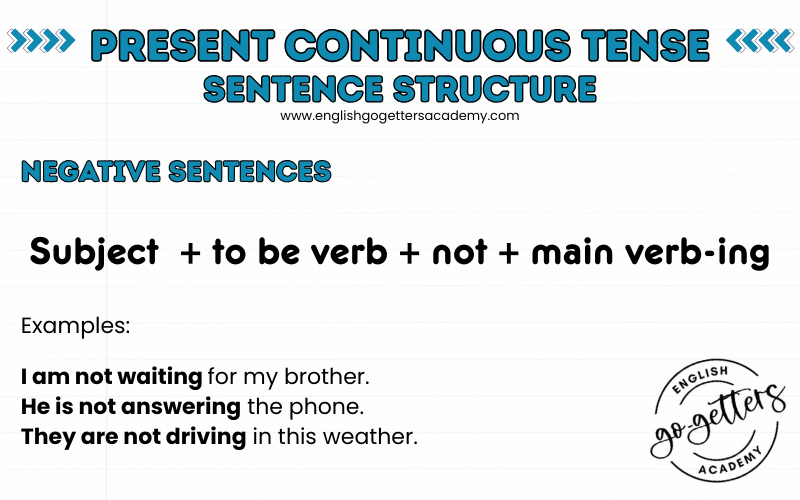
We form the negative with:
👉 subject + am / is / are + not + verb-ing
For example:
I am not working today.
She is not watching TV.
They are not studying for the test.
However, in spoken English, contractions are much more common.
Contractions in Present Continuous Negative
This is where your English starts to sound natural.
With I
✅ I’m not studying right now.
(We do NOT say I amn’t ❌)
With he / she / it
Instead of is not, we normally say:
✅ He isn’t sleeping.
✅ She isn’t working today.
With you / we / they
Likewise:
✅ We aren’t watching the movie.
✅ They aren’t playing soccer.
These contractions are much more common in real conversations.
If you want to sound natural in English — use them!
Present Continuous Negative Sentence Structure
| Subject | Verb to Be | Negative | Main Verb + ING |
| I | am | not | studying |
| He / She / It | is | not | studying |
| We / You / They | are | not | studying |
Now, let’s look at the sentence structure when using contractions.
I am not wearing glasses today.
He isn’t reading the book.
We aren’t cooking dinner.
| Subject | Verb to Be + Negative Contraction | Main Verb + ING |
| I | am not | studying |
| He / She / It | isn’t | studying |
| We / You / They | aren’t | studying |
Spelling Rules With -ING
In this post, we are focusing on the sentence structure of negative sentences, but I do explain in detail how and when to double the consonants in verbs when using the Present Continuous tense.
If you want to review:
✔ double consonants → run → running
✔ drop –e → make → making
✔ lie → lying
👉 Read the full guide here: Present Continuous Tense Practice for Beginners (A1–A2) | Affirmative Sentences
Present Continuous Negative for Actions Happening Now
We use it to say something is not happening at the moment of speaking.
Look for:
- now
- right now
- at the moment
Examples:
The baby isn’t sleeping right now.
I am not using my phone at the moment.
Present Continuous for Temporary Situations
Examples from real life:
I am not working this week — I’m on vacation.
She isn’t living in Chicago this year.
They aren’t studying for the exam this month.
This use is very common in English.
Present Continuous for Future Arrangements (Negative)
We can also use it for future plans that are NOT happening.
Examples:
We aren’t going out tonight.
He isn’t coming to the party.
Same structure — just add a future time expression.
Present Continuous Negative Practice for Beginners
Fill in the blanks:
1️⃣ I ______ (not / work) today.
2️⃣ She ______ (not / study) right now.
3️⃣ They ______ (not / watch) TV at the moment.
4️⃣ We ______ (not / have) lunch together this week.
5️⃣ He ______ (not / run) in the race today.
6️⃣ The children ______ (not / play) outside now.
7️⃣ I ______ (not / make) dinner tonight.
8️⃣ My friends ______ (not / travel) this month.
9️⃣ The dog ______ (not / sleep) in its bed.
🔟 You ______ (not / listen) to the teacher.
Challenge Time!
Want to make it more challenging?
Write negative sentences using the following phrasal verbs:
- wake up
- sit down
- come in
- go out
- take off
Examples:
I am not waking up early this week.
They aren’t sitting down at the table yet.
We aren’t going out tonight.
Answers
1️⃣ am not working / I’m not working
2️⃣ isn’t studying
3️⃣ aren’t watching
4️⃣ aren’t having
5️⃣ isn’t running
6️⃣ aren’t playing
7️⃣ am not making / I’m not making
8️⃣ aren’t traveling / travelling
9️⃣ isn’t sleeping
🔟 aren’t listening
Present Continuous – Frequently Asked Questions
Subject + am / is / are + not + verb-ing
or
I’m not / isn’t / aren’t + verb-ing
We use the Present Continuous tense in the negative form for:
– actions not happening now
– temporary situations
– future arrangements that are not planned
It is designed for A1–A2 learners.
You can download it in this post and practice with the video.
The answers are only in the video.
➡️ present continuous questions
Continue Learning
Next in the present continuous series:
➡️ Present continuous negative (you are here!)
➡️ Present continuous questions (coming soon)
You can also review the Present Continuous Tense with affirmative sentences here: Present Continuous Tense Practice for Beginners (A1–A2) | Affirmative Sentences
So don’t stop here!
Repeat the quiz, download the worksheet, and write your own examples in the comments.
The more you practice, the more natural your English becomes.
Happy learning, English Go-Getter!
Vanessa
English Go-Getters Academy