
Have you ever watched a cooking show in English, followed a recipe online, or tried to describe what you were making in the kitchen and realized…
“Wait… how do I say this in English?”
In fact, cooking verbs are one of those topics that seems simple at first — until you actually need the right word.
For example, is it boiling or steaming? Is it chopping or slicing? Is it frying or baking?
Similarly, do you know the difference between grating, peeling, and whisking?
Learning these cooking verbs can help you:
- follow recipes in English
- understand cooking shows and YouTube videos
- describe what you are doing in the kitchen
- talk about food and meals with confidence
- build vocabulary for everyday English conversations
- prepare for English exams like IELTS or TOEFL
In addition, this beginner-friendly English quiz includes 20 common cooking verbs with pictures and multiple-choice questions.
You will notice that some questions are easy… but some are designed to make you stop and think. 🤔
Can you get 18/20 or higher?
First, watch the video, then download the free worksheet, and finally see how many cooking verbs you already know!
Take the Quiz
Watch the quiz and choose your answers before time runs out.
Try not to pause!
Can you score:
🏆 18–20 → Cooking Vocabulary Expert
⭐ 14–17 → Excellent
💪 10–13 → Keep Practicing
📚 0–9 → Watch Again
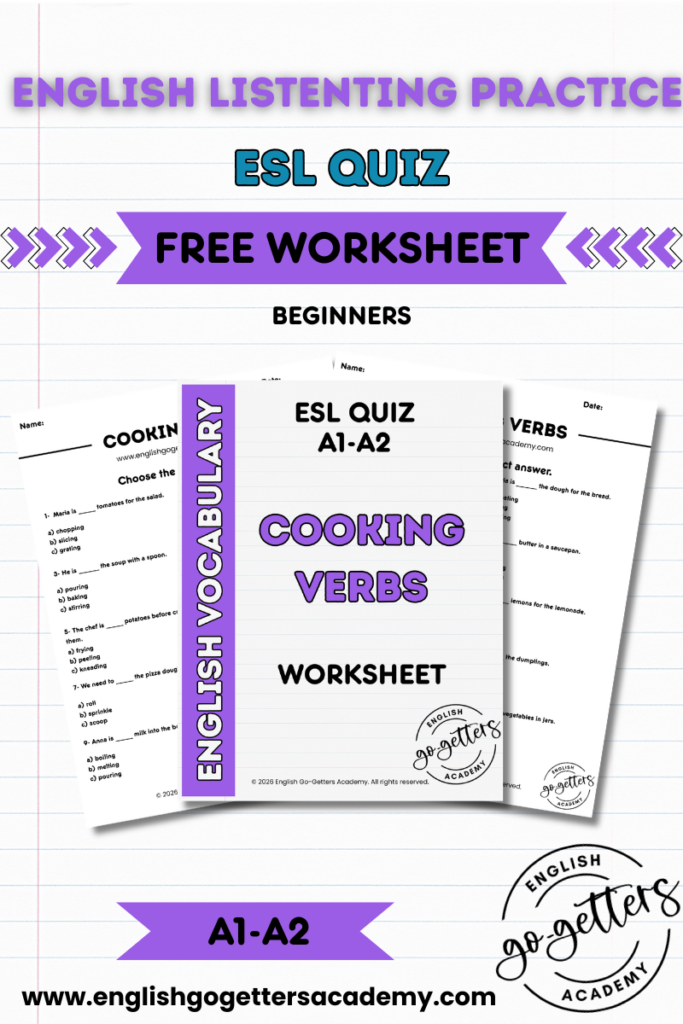
Download the Free Cooking Verbs Worksheet
Want extra practice?
If so, download the free printable worksheet and try answering all 20 questions by yourself.
This worksheet includes:
- 20 multiple-choice questions
- the same sentences from the video quiz
- beginner-friendly cooking vocabulary
- extra review after watching the video
Tip: Furthermore, try the worksheet before watching the answers to see your real score
Cooking Verbs Vocabulary List
Here are common cooking verbs in English. Some appeared in the quiz, and moreover, some are extra vocabulary to help you describe what happens in a real kitchen.
Cutting & Preparing
- chop → to cut food into small pieces with a knife
- slice → to cut food into thin flat pieces
- grate → to rub food against a grater to make small pieces
- peel → to remove the skin from a fruit or vegetable
- squeeze → to press a fruit to get the juice out
- roll → to flatten dough with a rolling pin
- scoop → to lift and move food with a spoon or scoop
Mixing & Combining
- stir → to move food around in a pan or bowl with a spoon
- whisk → to beat eggs, cream, or batter quickly to add air
- knead → to press and fold dough with your hands
- beat → to mix ingredients quickly and vigorously
- marinate → to soak food in a liquid before cooking to add flavour
- sprinkle → to scatter small amounts of something on top of food
Cooking with Heat
- boil → to cook food in very hot bubbling water (100°C)
- fry → to cook food in hot oil in a pan
- bake → to cook food in the oven using dry heat (for bread, cakes, cookies)
- roast → to cook meat or vegetables in an open dish in the oven
- grill → to cook food directly over or under heat
- steam → to cook food using steam from boiling water
- simmer → to cook food in liquid just below boiling point
Other Important Cooking Verbs
- melt → to heat something solid until it becomes liquid
- pour → to tip liquid from one container into another
- grease → to rub fat on a tin or pan so food doesn’t stick
- brown → to cook food until it turns golden or brown on the surface
- pickle → to preserve food in vinegar or brine
How many of these were new to you?
Extra Practice
Now that you’ve seen the vocabulary list, write 5 sentences using cooking verbs:
- I always…
- She is…
- We need to…
- He usually…
- Tomorrow I will…
For example:
I always chop the onions before I start cooking.
She is stirring the soup with a wooden spoon.
We need to marinate the chicken before we grill it.
He usually boils the pasta for about ten minutes.
Tomorrow I will bake cookies for the first time!
Common Cooking Verb Mistakes English Learners Make
These are mistakes many beginner students make because of translation, similar-sounding words, or because English has very specific cooking vocabulary that doesn’t always match other languages.
1. Chop × Slice × Cut
Many students use cut for everything. However, English separates them:
- cut → general word for dividing with a knife
- chop → quick, rough cuts into small pieces
- slice → long, thin, flat pieces
For example: You chop onions.
You slice bread.
You can cut both — but it’s less specific.
2. Boil × Steam × Simmer
In truth, these all use water and heat. However, they are very different:
- boil → food is IN the water, which is bubbling fast (100°C)
- steam → food is ABOVE the water, cooked by steam
- simmer → food is IN the liquid, but the heat is low and gentle
As a result, the texture and flavor of the food changes depending on which method you use.
3. Bake × Roast
Many learners use bake and roast as if they mean the same thing. To clarify:
- bake → oven heat for bread, cakes, cookies, pastry
- roast → oven heat for meat, vegetables, potatoes
For example:
You bake a cake.
You roast a chicken.
4. Stir × Whisk × Beat
These all involve mixing, but they are not the same. In fact:
- stir → slow circular movement with a spoon, usually in a pot or pan
- whisk → fast movement to add air (eggs, cream, sauces)
- beat → vigorous mixing to combine ingredients well (butter, batter)
5. Peel × Grate × Slice
These all involve preparing raw food before cooking. However:
- peel → remove the skin (potato, apple, carrot)
- grate → rub against a grater to make fine pieces (cheese, zucchini, lemon zest)
- slice → cut into thin flat pieces (cucumber, bread, meat)
Cooking Verbs FAQ
This quiz was created for beginner English learners (A1–A2). Specifically, you’ll practice cooking vocabulary that people use in everyday life, including words you might see in:
recipes in English
cooking shows and YouTube videos
restaurants and cafes
conversations about food and daily routines
English exams and vocabulary tests
If some words are new to you, don’t worry — that’s part of learning!
Because these are words you use every single day. For example, imagine situations like:
– reading a recipe in English and not understanding the instructions
– watching a cooking show and missing what the chef is doing
– describing your favorite dish to someone in English
– shopping for ingredients and not knowing the right vocabulary
– following a food video on YouTube or Instagram
If you know verbs like chop, boil, fry, bake, and stir, everyday conversations about food become much easier.
First of all, start with the most useful and common ones:
– chop
– slice
– boil
– fry
– bake
– stir
– pour
– peel
– mix
– grill
– roast
– steam
Once those feel comfortable, then move on to more specific verbs like whisk, knead, marinate, and simmer.
In fact, both use the oven — but the difference is the type of food. To clarify:
– baking → for bread, cakes, cookies, muffins, pies
– roasting → for meat, chicken, vegetables, potatoes
For example, you bake a birthday cake. You roast a chicken for dinner.
Both use water and heat. However, the key difference is whether the food touches the water:
– boiling → food is submerged IN the water
– steaming → food is placed ABOVE the water and cooked by the steam
As a result, steamed vegetables often keep more of their color, flavor, and nutrients than boiled ones.
Try this simple method:
– First, watch the quiz video
– Then, complete the worksheet
– Next, go to your kitchen and say the verbs out loud as you cook
– After that, write 3 sentences using new verbs
– Finally, use the words again the next time you cook or talk about food
For example: I am chopping the onions. She is stirring the sauce. We are baking a cake.
First of all, that’s completely normal — especially with cooking verbs, because many of them look and sound similar. Vocabulary grows with repetition. Therefore, watch the video again in a few days and compare your score. You might be surprised how many verbs you remember the second time!
If you enjoyed this quiz, then explore more vocabulary practice, worksheets, and beginner English quizzes on English Go-Getters Academy or visit my YouTube Channel.
Great job making it to the end of this cooking verbs quiz!
Learning English doesn’t happen by memorizing long lists — instead, it happens by seeing words in context, hearing them, using them in real situations, and then coming back to practice again.
Today you practiced 20 cooking verbs in English. More importantly, you learned vocabulary that you can use every time you cook, read a recipe, or watch a cooking video.
As a result, the next time you’re in the kitchen, try to say out loud what you’re doing in English:
- I am chopping the carrots.
- The water is boiling.
- I need to peel the potatoes.
- She is whisking the eggs.
- We are baking bread today.
And if some verbs still feel difficult… remember that’s completely normal.
Most learners don’t remember new vocabulary after seeing it only once. Therefore, the goal isn’t to get a perfect score today — the goal is to understand a little more each time you practice.
In summary, my suggestion is:
- Watch the video again in a few days
- Complete the worksheet one more time
- Try using 3–5 new cooking verbs in your own sentences
- Cook something and describe what you’re doing — out loud, in English!
As a result, you’ll probably remember more than you expect.
Keep Learning
In the meantime, while I prepare more quizzes for you, check other quizzes that are already available to watch and practice English today!
Be sure to subscribe to the YouTube Channel so you won’t miss any new videos coming up!
- Vocabulary Quiz: Parts of the Body
- Vocabulary Quiz: Flowers in English
- Vocabulary Quiz: Bathroom Words in English
- Grammar Quiz: Simple Present Continuous
- Listening Quiz: Minimal Pairs Part 1
- Listening Quiz: Minimal Pairs Part 2
Remember, the more ways you practice English, the faster your vocabulary grows.
Thank you for learning with me today!
Happy Learning!
Vanessa
English Go-Getters Academy