
Have you ever finished a conversation in English and thought…
“Was that sentence correct? Or did I make a grammar mistake?”
In fact, grammar is one of those things that feels fine — until someone asks you to choose the right answer.
For example, do you know when to use has or have? Is it went or have gone? Is it to study or studying?
Similarly, do you know the difference between had left and have left? Or when to use who, which, or that?
This 50-question English grammar quiz will test your knowledge of:
- verb tenses (present simple, past simple, present perfect, past perfect, future perfect)
- conditionals (first, second, and third)
- relative clauses (who, which, that)
- gerunds and infinitives
- tag questions
- passive voice
- reported speech
- quantifiers and pronouns
- comparatives and superlatives
In addition, this quiz covers grammar that real native speakers use every day — not just textbook rules.
You will notice that some questions are straightforward… but some are designed to make you stop and think.
Can you score 45 or higher?
First, watch the video, then download the free worksheet, and finally check how many grammar rules you already know!
Take the Quiz
Watch the quiz and choose your answers before time runs out.
Try not to pause!
Can you score:
🏆 45–50 → Grammar Expert — Near Native Level!
🥇 35–44 → Advanced — Excellent Work!
💪 25–34 → Intermediate — Keep Practicing!
📚 0–24 → Watch Again — You’re Learning!
Download the Free Worksheet
Want to test yourself before watching the answers?
If so, download the free printable worksheet and try answering all 50 questions on your own first.
This worksheet includes:
- 50 multiple-choice grammar questions
- the same sentences from the video quiz
- a mix of beginner, intermediate, and advanced grammar
- space to write your score and track your progress
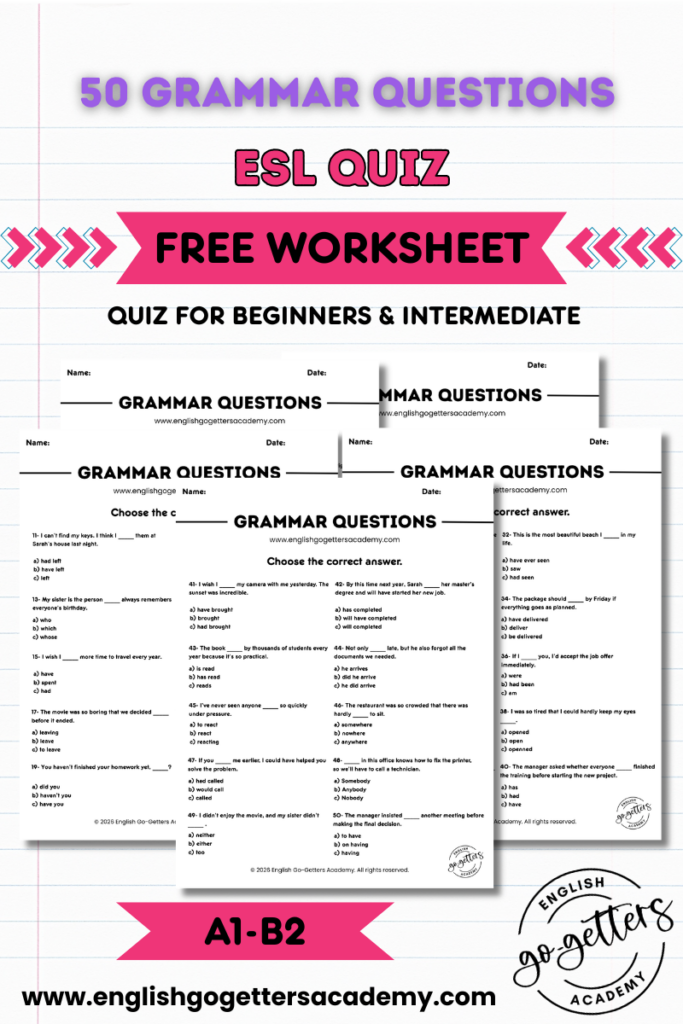
Tip: Try the worksheet before watching the answers to see your real score!
Grammar Topics Covered in This Quiz
Here is a quick overview of the grammar topics in this quiz. Some of these might feel easy — and some might surprise you!
Verb Tenses
- Simple present → for routines and habits (Emma usually has breakfast…)
- Simple past → for finished actions with a past time reference (We went to the mall last Saturday…)
- Present perfect → for experiences and actions connected to now (My brother has lived in Chicago since…)
- Past perfect → for actions completed before another past action (By the time we arrived, the flight had already left…)
- Future perfect → for actions that will be complete before a future point (By next June, my parents will have lived here for twenty years…)
Conditionals
- First conditional → real, possible situations (If Mark studies harder, he’ll pass…)
- Second conditional → unreal present situations (If I were you, I’d accept the offer…)
- Third conditional → unreal past situations (If you had called me earlier, I could have helped you…)
Gerunds and Infinitives
This is one of the most common grammar challenges for English learners — and this quiz has several questions on it!
- My teacher suggested reviewing the vocabulary… (suggest + gerund)
- My sister decided to study abroad… (decide + infinitive)
- Would you mind closing the window? (mind + gerund)
- The manager insisted on having another meeting… (insist on + gerund)
Other Grammar Points
- tag questions (Your parents have already arrived, haven’t they?)
- passive voice (The package should be delivered by Friday…)
- relative clauses (My sister works for a company that/which exports…)
- subject-verb agreement with neither (Neither of the answers is correct…)
- inversion with not only (Not only did he arrive late, but he also forgot…)
- wish clauses (I wish I had more time… / I wish I had brought my camera…)
Common Grammar Mistakes English Learners Make
These are mistakes that many intermediate students make — because the rules are similar but not the same.
1. Present Perfect × Simple Past
Many learners mix these two tenses. Here is the key difference:
- Use simple past when you have a specific time in the past (last Saturday, yesterday, in 2019)
- Use present perfect when there is no specific time, or when the action connects to now (since 2019, for ten years, already, ever)
For example:
We went to the mall last Saturday. ✅ (specific past time)
My brother has lived in Chicago since he graduated. ✅ (from the past until now)
2. Gerund × Infinitive
Some verbs are followed by a gerund (-ing). Others are followed by an infinitive (to + verb). Some change meaning depending on which form you use!
Gerund (-ing) after: suggest, mind, consider, enjoy, avoid, finish, remember (past action), forget (past action)
Infinitive (to + verb) after: decide, want, hope, plan, choose, need, remember (future action), forget (future action)
For example:
I remember locking the door. ✅ (I have a memory of doing it — past)
Remember to lock the door. ✅ (Don’t forget to do it — future)
3. Who × Which × That
These are all relative pronouns, but they are not always interchangeable:
- who → for people (My sister is the person who always remembers everyone’s birthday.)
- which → for things, especially in non-defining clauses (The book, which was very long, took me three weeks to read.)
- that → for things in defining clauses (My sister works for a company that exports medical equipment.)
Note: In everyday English, that and which are often used interchangeably for things in defining clauses. Both are correct!
4. Neither × Either × Both
These cause a lot of confusion — especially with subject-verb agreement:
- neither of + plural noun → singular verb (Neither of the answers is correct.)
- neither… nor… → verb agrees with the closest subject (Neither my brother nor my parents are coming.)
- either → used in negative additions (I didn’t enjoy it, and my sister didn’t either.)
- neither → used in negative additions with inversion (I didn’t enjoy it, and neither did my sister.)
5. Too × Enough × Very
These all modify adjectives or adverbs, but they mean different things:
- too → more than what is needed or wanted (This coffee is too hot for me to drink.)
- enough → the right amount (There weren’t enough chairs for everyone.)
- very → intensifies but does not suggest a problem (She speaks very fluently.)
Extra Practice
Now that you’ve reviewed the grammar points, write 5 sentences using what you learned:
- I usually…
- She has…
- If I…
- By this time next year, I…
- I wish I…
For example:
I usually have breakfast before leaving the house.
She has lived in this city since she was a child.
If I knew her address, I would visit her more often.
By this time next year, I will have finished my English course.
I wish I had studied harder when I was younger.
Grammar Quiz FAQ
This quiz was created for intermediate English learners (B1–B2). However, some questions will challenge even advanced learners! Topics include:
verb tenses, conditionals, gerunds and infinitives, passive voice, relative clauses, tag questions, inversion, and subject-verb agreement.
If some questions were difficult, that’s completely normal — that’s how you find the areas to focus on next.
Because grammar rules only become automatic when you see them in context. For example, you might know the rule for present perfect — but in a quiz, you have to choose the right answer quickly and under a little pressure. That’s much closer to real conversation than memorizing a table. Seeing grammar in real sentences helps your brain recognize the patterns faster.
Both are unreal — they describe situations that are not true.
The difference is the time:
– second conditional → unreal present or future (If I knew her address, I would visit her. = I don’t know it now.)
– third conditional → unreal past (If you had called me, I could have helped you. = You didn’t call.)
“Neither of” is always followed by a singular verb, even if the noun after it is plural. For example: – – Neither of the answers is correct.
– Neither of the students was ready.
With “neither… nor…“, the verb agrees with the subject closest to it:
– Neither my brother nor my parents are coming. (closest subject: parents = plural)
Inversion means changing the normal word order (subject + verb) to put the verb or auxiliary before the subject. It is used after negative or limiting expressions like not only, never, hardly, and seldom:
– Not only did he arrive late, but he also forgot the documents.
This structure is more common in formal and written English, but native speakers use it in speech too.
That means you found exactly what to practice next — and that’s the whole point! Vocabulary and grammar grow with repetition. Therefore, watch the video again in a few days and compare your score. You might be surprised how many rules you remember the second time around.
If you enjoyed this quiz, explore more grammar practice, worksheets, and beginner English quizzes on English Go-Getters Academy or visit my YouTube Channel.
Great job making it to the end of this grammar quiz!
Learning grammar doesn’t happen by memorizing rules from a textbook — instead, it happens by seeing the rules in action, noticing your mistakes, and then coming back to practice again.
Today you tested yourself on 50 real English grammar structures. More importantly, you now know exactly which grammar points you need to review.
As a result, the next time you speak or write in English, try to pay attention to:
- which tense sounds right in context
- whether to use a gerund or an infinitive
- how to form tag questions naturally
- whether the subject is singular or plural
And if some questions still feel confusing… remember that’s completely normal.
Most learners need to see a grammar rule many times before it feels automatic. Therefore, the goal isn’t to score perfectly today — the goal is to understand a little more each time you practice.
In summary, my suggestion is:
- Watch the video again in a few days
- Complete the worksheet one more time
- Write 5 sentences using the grammar points you found most difficult
- Pay attention to these structures in English songs, videos, and conversations
As a result, you’ll probably remember more than you expect.
Keep Learning
In the meantime, while I prepare more quizzes for you, check other quizzes that are already available to watch and practice English today!
Be sure to subscribe to the YouTube Channel so you won’t miss any new videos coming up!
- Vocabulary Quiz: Cooking Verbs in English
- Vocabulary Quiz: Parts of the Body
- Vocabulary Quiz: Flowers in English
- Vocabulary Quiz: Bathroom Words in English
- Grammar Quiz: Simple Present Continuous
- Listening Quiz: Minimal Pairs Part 1
- Listening Quiz: Minimal Pairs Part 2
Remember, the more ways you practice English, the faster your grammar improves.
Thank you for learning with me today!
Happy Learning!
Vanessa
English Go-Getters Academy