
Have you ever looked at a sentence and thought…
“Is it TO DO or DOING? I never know which one to use!”
In fact, gerunds and infinitives are one of the most confusing grammar topics in English, even for intermediate and advanced learners.
For example, do you know why we say I enjoy hiking but I decided to hike? Or why he stopped smoking and he stopped to smoke mean completely different things?
Similarly, do you know why I’m looking forward to seeing you is correct, but I’m looking forward to see you is wrong?
This 50-question quiz will test your knowledge of:
- verbs followed by a gerund (-ing form)
- verbs followed by an infinitive (to + verb)
- verbs that change meaning depending on which form you use
- prepositions followed by a gerund
- fixed expressions with gerunds and infinitives
- perception verbs and how they work
In addition, this quiz covers grammar patterns that real native speakers use every day, not just textbook lists.
You will notice that the first questions are more straightforward… but the last 10 are designed to make even advanced learners stop and think.
Can you score 50/50?
First, watch the video, then download the free worksheet, and finally check how many rules you already know!
Take the Quiz
Watch the quiz and choose your answers before time runs out.
Try not to pause!
Can you score:
46–50 → Gerund & Infinitive Master — Near Native Level!
36–45 → Advanced — Excellent Work!
26–35 → Intermediate — Great Progress!
16–25 → Keep Studying — You’re Getting There!
0–15 → Beginner — Don’t Give Up — Watch Again!
Download the Free Worksheet
Want to test yourself before watching the answers?
If so, download the free printable worksheet and try answering all 50 questions on your own first.
This worksheet includes:
- 50 multiple-choice questions on gerunds and infinitives
- the same sentences from the video quiz
- questions ranging from intermediate to advanced level (B1–B2)
- space to write your score and track your progress
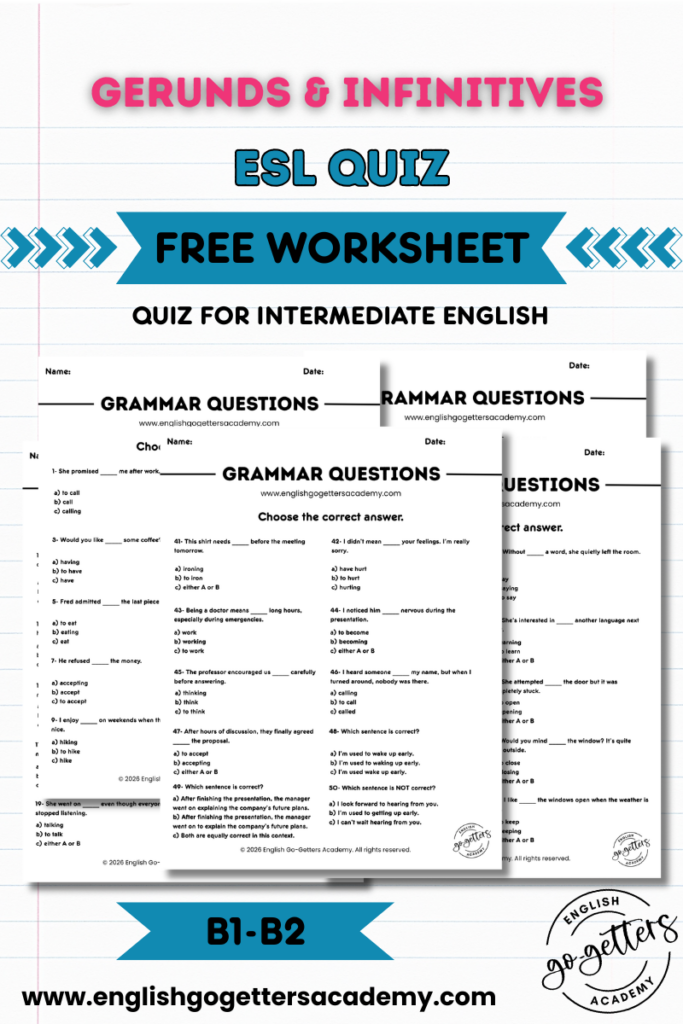
Tip: Try the worksheet before watching the answers to see your real score!
What Are Gerunds and Infinitives?
Before we look at the quiz topics, here is a quick review of the two forms.
A gerund is a verb that ends in -ing and works as a noun in a sentence.
I enjoy hiking on weekends.
She admitted eating the last piece of cake.
An infinitive is the base form of a verb, usually with TO in front of it.
She promised to call me after work.
He refused to accept the money.
The challenge is that some verbs are always followed by a gerund, some are always followed by an infinitive, and some can take both forms — sometimes with the same meaning, and sometimes with a completely different meaning!
Grammar Topics Covered in This Quiz
Here is a quick overview of what this quiz covers. Some sections will feel manageable — and some will definitely surprise you!
Verbs Followed by a Gerund
These verbs are always followed by -ing. There are no exceptions!
- avoid: My brother avoids talking about politics.
- admit: Fred admitted eating the last piece of cake.
- finish: We finished writing the report just before the deadline.
- enjoy: I enjoy hiking on weekends.
- consider: My sister considered moving to another city.
- mind: I don’t mind staying late if there is a lot of work to do.
- can’t help: I can’t help crying whenever I watch that movie.
- give up: She gave up eating sugar completely last January.
Verbs Followed by an Infinitive
These verbs are always followed by TO + verb.
- promise: She promised to call me after work.
- decide: My brother decided to learn a new language this year.
- refuse: He refused to accept the money.
- agree: I agreed to meet them at the restaurant.
- need: She needs to renew her passport before traveling abroad.
- afford: They can’t afford to buy a new car right now.
- choose: We chose to eat at the new Italian restaurant downtown.
- encourage: The professor encouraged us to think carefully before answering.
Verbs That Accept Both Forms
Some verbs work with both gerunds and infinitives without any change in meaning. These include:
- hate: He hates waiting / hates to wait for people who are always late.
- like: I like keeping / like to keep the windows open when the weather is nice.
- prefer: I prefer cooking / prefer to cook at home rather than eating out.
- continue: The teacher continued explaining / continued to explain while the students took notes.
- start / begin: It started raining / started to rain while we were walking home.
- attempt: She attempted to open / attempted opening the door but it was completely stuck.
Verbs That Change Meaning
This is where it gets really interesting, and really tricky!
Some verbs have completely different meanings depending on whether they are followed by a gerund or an infinitive. These are the questions that trip up even advanced learners.
STOP
He stopped smoking after his doctor told him it was dangerous.
- He quit smoking completely. He no longer smokes.
On the way home, she stopped to buy some groceries at the supermarket.
- She paused her journey in order to go shopping. She did not quit shopping!
TRY
He tried to lift the heavy box, but it was too heavy.
- He made an effort, but he couldn’t do it.
Why don’t you try leaving earlier tomorrow? You might avoid the traffic.
- Experiment with this solution and see if it helps.
GO ON
She went on talking even though everyone had stopped listening.
- She continued doing the same thing without stopping.
After a short break, he went on to make a completely different point.
- He moved on to something new and different.
MEAN
I didn’t mean to hurt your feelings. I’m really sorry.
- I didn’t intend to do it.
Being a doctor means working long hours, especially during emergencies.
- Being a doctor involves or requires long hours.
Prepositions Followed by a Gerund
This is one of the most important rules in this quiz — and one that learners often miss.
After a preposition, always use a gerund (-ing form), never an infinitive.
- look forward to: I’m looking forward to hearing from you soon.
- interested in: She’s interested in learning another language next year.
- good at: She is good at making people feel comfortable.
- thinking of: I am thinking of renting a new apartment closer to work.
- instead of: Instead of complaining about the problem, let’s find a solution.
- without: Without saying a word, she quietly left the room.
The most common mistake: I’m looking forward to see you.
The TO in look forward to is a preposition, not part of the infinitive. That’s why it must be followed by -ing, not a base verb.
The same rule applies to used to + ING (accustomed to something) and in addition to + ING.
Fixed Expressions with Gerunds
Some expressions are always followed by a gerund. These are fixed patterns — memorize them!
- it’s no use: It’s no use worrying about things you cannot change.
- it’s worth: This book is definitely worth reading.
- can’t help: I can’t help laughing every time I hear that joke.
- have difficulty: He had difficulty understanding what the speaker was saying.
- spend time: She spent the whole afternoon looking for her missing keys.
Common Mistakes with Gerunds and Infinitives
These are the mistakes that intermediate learners make most often, because the rules look similar but are not the same.
1. WOULD LIKE vs LIKE
Many learners treat these two the same way. They are not!
- would like: always followed by TO + verb = Would you like to have some coffee?
- like: followed by ING or TO + verb (both correct) = I like having coffee in the morning. OR I like to have coffee in the morning. ✅
2. STOP + ING vs STOP + TO
This is the most common meaning-change mistake.
He stopped smoking = he quit. That means he no longer smokes.
He stopped to smoke = he paused what he was doing in order to smoke.
These mean the opposite of each other. The context always tells you which one is correct.
3. LOOK FORWARD TO + ING
This trips up even advanced learners because the TO looks like part of the infinitive, but it is a preposition.
I look forward to seeing you.
The same rule applies to: I’m used to waking up early. (accustomed to it — TO is a preposition)
I used to wake up early. (but not anymore — different structure entirely!)
4. NEED + ING (passive meaning)
This is one of the trickiest structures in the quiz.
This shirt needs ironing. = This shirt needs TO BE ironed. Someone needs to iron it.
The shirt is not doing the ironing — it is receiving the action. NEED + ING has a passive meaning when the subject is a thing, not a person.
She needs to iron the shirt. = She is the person doing the ironing. This is active.
5. IT’S NO USE + ING
This is a fixed expression. It never takes an infinitive.
It’s no use worrying about things you cannot change.
Extra Practice
Now that you’ve reviewed the main rules, try writing 5 sentences of your own:
- I enjoy…
- I decided…
- She stopped…
- I’m looking forward to…
- It’s no use…
For example:
I enjoy reading before going to sleep.
I decided to start exercising three times a week.
She stopped to check her phone when she heard the notification.
I’m looking forward to visiting my family next month.
It’s no use worrying about things that haven’t happened yet.
Gerunds and Infinitives FAQ
This quiz is designed for intermediate to upper intermediate learners (B1–B2). The first section covers basic verb patterns that B1 learners will recognize. The middle and final sections cover meaning-changing verbs, prepositions, and fixed expressions that are more challenging at B2 level. If some questions were difficult, that’s completely normal — gerunds and infinitives are one of the trickiest areas of English grammar even for advanced learners!
There is no single logical rule that explains all cases, which is exactly what makes this topic so challenging! In general, gerunds (-ing forms) tend to describe actions that are already happening, completed, or habitual.
Infinitives (TO + verb) tend to point toward future actions, intentions, or goals. However, the most reliable approach is to learn the most common verbs in each group and notice them in real sentences as you read and listen in English.
This is one of the most important distinctions in this quiz! STOP + ING means you quit doing something completely. STOP + TO + verb means you pause what you are doing in order to do something else. For example: “He stopped smoking” means he quit smoking for good. “He stopped to smoke” means he paused what he was doing in order to have a cigarette — the complete opposite meaning!
Because the TO in “look forward to” is a preposition, not part of the infinitive. In English, prepositions are always followed by a noun or a gerund (-ing form), never a bare infinitive. This is the same rule that applies to “interested in doing”, “good at doing”, “thinking of doing”, and “used to doing.”
When NEED is followed by a gerund and the subject is a thing (not a person), the meaning is passive. “This shirt needs ironing” means the shirt needs to be ironed — someone needs to iron it. Compare this with “She needs to iron the shirt” where the person is doing the action. This passive meaning with NEED + ING is common in everyday English and is worth memorizing as a pattern.
If you enjoyed this quiz, explore more grammar practice, worksheets, and quizzes on English Go-Getters Academy or visit my YouTube Channel.
Great job making it to the end of this quiz!
Gerunds and infinitives are genuinely one of the most challenging areas of English grammar, so if you found some questions difficult, you are in very good company. Even advanced learners make mistakes with meaning-changing verbs like STOP, TRY, and GO ON.
Today you tested yourself on 50 real grammar structures that native speakers use every day. More importantly, you now know exactly which patterns to focus on next.
The next time you speak or write in English, try to pay attention to:
- which verbs are followed by -ing and which take TO + verb
- whether the TO in a phrase is part of the infinitive or a preposition
- how context clues help you choose the right form with meaning-changing verbs
- fixed expressions like IT’S NO USE and CAN’T HELP that always take -ing
And if some structures still feel confusing… remember that’s completely normal.
Most learners need to see a grammar pattern many times before it feels automatic. Therefore, the goal isn’t to score perfectly today — the goal is to understand a little more each time you practice.
My suggestion is:
- Watch the video again in a few days
- Complete the worksheet one more time without looking at the answers
- Write 5 sentences using the patterns you found most difficult
- Notice gerunds and infinitives in English songs, videos, and conversations
You will probably remember more than you expect.
Keep Learning
In the meantime, while I prepare more quizzes for you, check other quizzes that are already available to watch and practice English today!
Be sure to subscribe to the YouTube Channel so you won’t miss any new videos coming up!
- Grammar Quiz: 50 English Grammar Questions
- Vocabulary Quiz: Cooking Verbs in English
- Vocabulary Quiz: Parts of the Body
- Vocabulary Quiz: Flowers in English
- Vocabulary Quiz: Bathroom Words in English
- Grammar Quiz: Simple Present Continuous
- Listening Quiz: Minimal Pairs Part 1
Remember, the more ways you practice English, the faster your grammar improves.
Thank you for learning with me today!
Happy Learning!
Vanessa
English Go-Getters Academy